Berkeley CS188: Introduction to Artificial Intelligence
Contents · 52
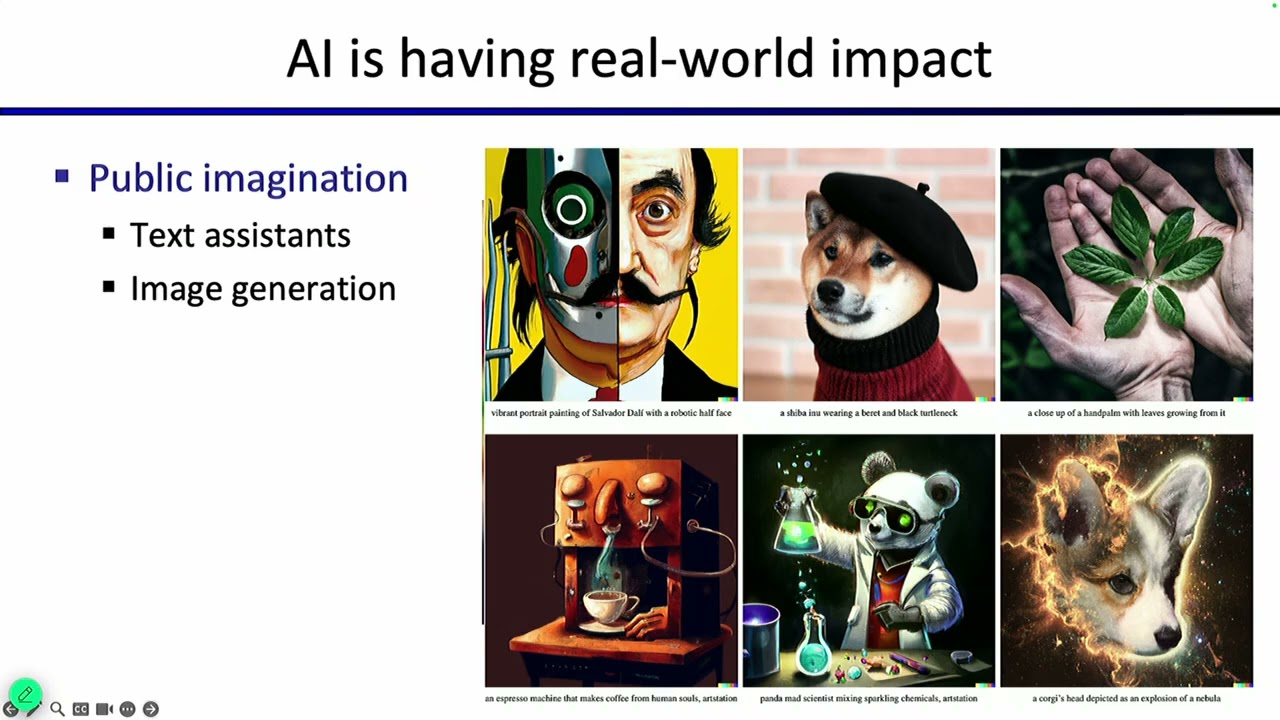
- 01-IntroIntroduces CS 188 logistics, grading, support, and academic policies, then surveys AI’s capabilities and real-world impact.
- 01-IntroIntroduces the instructors, course structure, attendance options, exams, course resources, assignments, and extension policies.
- 02-Uninformed SearchIntroduces AI search and planning agents, modeling search problems and state spaces, and uninformed methods including depth-first, breadth-first, and uniform-cost search.
- 02-Uninformed SearchIntroduction to search problems, planning agents, practical applications, and the contrast between reflex and goal-directed behavior.
- 03-A* Search and HeuristicsHeuristics and informed search strategies, including greedy best-first search, A*, admissibility, and optimality.
- 03-A* Search and HeuristicsIntroduces informed search and heuristics, contrasting uninformed search with greedy search and A*; reviews search problem concepts and graph search.
- 04-CSPs IIntroduces CSPs, including variables, domains, constraints, and applications, then explains backtracking search and constraint-aware problem solving.
- 04-CSPs IIntroduces constraint satisfaction problems, contrasting assignment-based goals with pathfinding and defining variables, domains, and constraints. Begins the map-coloring example using Australia’s states.
- 05-CSPs IICovers arc and k-consistency, CSP search improvements, tree-structured problems, cutset conditioning, and tree decomposition.
- 05-CSPs IIReviews constraint satisfaction problems, backtracking search and heuristics, then introduces arc consistency and constraint-graph structure.
- 06-Game Trees IIntroduces minimax search for deterministic, zero-sum games and alpha–beta pruning, including their implementation, efficiency, and properties.
- 06-Game Trees IHistory and milestones in computer game playing, plus how general-purpose search algorithms produce intelligent behavior from game rules.Milestones in computer game playing and how general-purpose search algorithms produce intelligent behavior from game rules.
- 07-Game Trees IICovers expectimax and expectiminimax search, probability models, expected utility, and the risks of mismatching assumptions about an opponent or environment.
- 07-Game Trees IIExplains alpha-beta pruning with minimax game trees, tracking value bounds and identifying branches that can be skipped.
- 08-MDPs IDefines Markov decision processes, stochastic transitions, rewards, policies, and discounted utility, with gridworld and racing examples.
- 08-MDPs IIntroduces Markov decision processes, expectimax search, and reinforcement learning, with examples of planning under uncertain action outcomes.
- 09-MDPs IICovers Bellman equations, value iteration and convergence, policy evaluation, and extracting optimal actions from state values.
- 09-MDPs IIRecaps grid-world uncertainty, MDP states, actions, transitions, rewards, discounting, and start states, then introduces policies for choosing actions across states.
- 10-RL IIntroduces reinforcement learning, model-based and model-free learning, passive policy evaluation, direct evaluation, and learning state values from experience.
- 10-RL IIntroduces reinforcement learning as agents learning from rewards, with examples in animal training, robot soccer, and robotics.
- 11-RL IICovers model-free Q-learning, exploration and regret, and feature-based approximate Q-learning for generalizing across states.
- 11-RL IIIntroduces reinforcement learning with unknown MDP transitions and rewards, contrasting model-based learning with offline planning and policy evaluation.
- 12-ProbabilityProbability fundamentals for AI: random variables, joint and marginal distributions, conditional probabilities, Bayes’ rule, inference, and independence.
- 12-ProbabilityIntroduces random variables and joint, marginal, and conditional distributions, using a noisy-sensor Ghostbusters game to illustrate reasoning under uncertainty.
- 13-Bayes Nets: RepresentationIntroduces independence and conditional independence, Bayesian network structure, and how local conditional probabilities factorize joint distributions.
- 13-Bayes Nets: RepresentationReviews probabilistic inference, explaining query, evidence, and hidden variables and the enumeration steps of filtering, summing out, and normalization.
- 14-Bayes Nets: IndependenceExplains conditional independence in Bayesian networks, including causal chains, common causes, v-structures, and d-separation for identifying when evidence blocks or activates influence between variables.
- 14-Bayes Nets: IndependenceExplains how Bayesian networks encode joint distributions using conditional probability tables and the reconstitution formula.
- 15-Bayes Nets: InferenceBayesian network inference methods, including enumeration, factor operations, and variable elimination. Covers evidence handling, marginalization, normalization, and computational complexity.Bayesian network inference using enumeration and variable elimination, with factors, evidence, marginalization, normalization, and complexity.
- 15-Bayes Nets: InferenceExplains d-separation for Bayesian networks, using active and blocked paths to determine conditional independence, with examples involving rain, traffic, and a ball game.
- 16-Bayes Nets: SamplingBayesian network sampling methods: prior sampling, rejection sampling, likelihood weighting, and Gibbs sampling for approximate inference.
- 16-Bayes Nets: SamplingVariable elimination ordering, factor growth, and inference complexity in Bayesian networks, including why no efficient ordering exists in the general case.
- 17-Decision Networks and VPIDecision networks model action choices and expected utility; value of information measures the benefit of new evidence. The slides also introduce partially observable Markov decision processes (POMDPs) and belief states.
- 17-Decision Networks and VPIDecision networks for choosing actions that maximize expected utility, and how evidence informs decisions.
- 18-HMMsExplains Markov chains and hidden Markov models, including state transitions, emissions, conditional independence, stationary distributions, and applications such as weather, PageRank, and speech recognition.
- 18-HMMsIntroduces hidden Markov models for sequential inference, reviewing probability rules, independence, and applications in speech recognition, robot localization, and medical monitoring.
- 19-Particle FilteringExplains HMM filtering and particle-filter prediction, weighting, and resampling, with applications to robot localization and SLAM.
- 19-Particle FilteringReviews Markov and hidden Markov models, their transition and observation probabilities, and how their time-series structure supports efficient inference.
- 20-ML I: Naive BayesIntroduces supervised classification and Naïve Bayes, covering conditional independence, parameter estimation, posterior inference, and bag-of-words text models.
- 20-ML I: Naive BayesIntroduces machine learning as learning models from data, then explains classification through a spam-filter example and the naive Bayes approach.
- 21-ML II: PerceptronsLinear classification with binary and multiclass perceptrons, their learning rules and limitations, and logistic regression’s probabilistic predictions and maximum-likelihood training.
- 21-ML II: PerceptronsCovers classification baselines, including majority-class prediction, and classifier confidence and calibration.
- 22-ML III: Neural NetworksCovers gradient-based optimization, logistic regression training, neural network architectures, activation functions, feature learning, and universal approximation.
- 22-ML III: Neural NetworksIntroduction to linear classifiers, logistic regression, sigmoid probabilities, and maximum likelihood estimation.
- 23-ML IV: Applications & Decision TreesIntroduces inductive learning and the consistency–simplicity tradeoff, then covers decision-tree expressiveness, feature interactions, hypothesis spaces, information gain, and overfitting. It also wraps up neural-network capabilities and practical uses.
- 23-ML IV: Applications & Decision TreesNeural network layers, nonlinear activations, learned features, architectures, and training weights.
- 24-ML V: TransformersExplains LLM tokenization, embeddings, autoregressive generation, attention and transformers, plus self-supervised pretraining, fine-tuning, and instruction tuning.
- 24-ML V: TransformersTokenization, transformer architecture, next-token prediction, and supervised, semi-supervised, and human-feedback reinforcement learning for large language models.
- 25-Applications: AI for HealthcareCovers healthcare AI evaluation, contrasting benchmark-based testing of predictive models with fidelity, diversity, and expert assessment of generative models.
- 25-Applications: AI for HealthcareAI applications in healthcare, including predictive and generative models, clinical imaging, evaluation, and research resources at Berkeley and UCSF.
- 26-Applications: AI for Equality and Course Wrap-upAI’s role in addressing inequality, including disparities in pain and policing, and reflections on the future of AI and the course.
- 26-Applications: AI for Equality and Course Wrap-upExplains how AI can help address inequality in pain assessment and policing, examines bias in AI systems, and discusses the course wrap-up and next steps in AI.